Disclaimer: The following narrative is constructed from a collection of recovered journals, police transcripts from the fateful night of February 12, 1998, and interviews with the surviving family members. To protect their privacy, names and specific locations in West Virginia have been altered
Part I: The Isolation
The isolation of the Appalachian Mountains is deceptive. In the summer, it feels like a green, lush embrace. But in the dead of winter, when the trees are stripped bare and look like skeletal fingers clawing at the grey sky, it feels like a cage.
For Sarah and David, the farmhouse on Blackwood Creek was supposed to be their sanctuary. Purchased for a suspiciously low price in the late autumn of 1997, it sat on forty acres of dense pine forest, miles away from the nearest paved road. Sarah was eight months pregnant, glowing with the anticipation of their first son. They were young, city-tired, and desperate for clean air and quiet nights to raise a family. They wanted to escape the noise.
They got the quiet. But the silence of the mountains is heavy. It presses against your ears. And in that silence, you start to hear things that shouldn’t be there.
It started subtly, about two weeks after they moved in. David was a long-haul trucker, which meant Sarah spent stretches of four or five days alone in the creaking, drafty house. At first, she loved the solitude. But slowly, the house began to feel less like a home and more like an organism that was tolerating their presence.
The first sign was the smell. Sarah would wake up abruptly at 3:00 AM, gasping for air, choking on a stench that filled the master bedroom. In her journal, she described it vividly: “It smells like wet animal fur and burning hair. It’s thick, oily. It sticks to the back of my throat.”
She blamed it on the old furnace, or perhaps a dead raccoon in the crawlspace. She blamed her heightened pregnancy hormones. She scrubbed the floors with bleach until her hands were raw and red, trying to mask it. But the smell always returned, usually when David was gone, and it always seemed to hover specifically around the door of the nursery they were painting yellow.
Part II: The Offerings
Then came the gifts.
It began with small things that Sarah tried to rationalize. A dead crow placed perfectly in the center of the driveway, its neck broken at an unnatural angle. Strange piles of stones arranged in triangles near the mailbox.
But the escalation was rapid. One Tuesday morning, Sarah went out to the porch to drink her herbal tea and found a small bundle sitting on the “Welcome” mat. It was wrapped in dirty, red flannel—the fabric stiff with age and grime. Against her better judgment, she nudged it open with the toe of her boot.
Inside was a collection of small, hollow bird bones, wrapped tightly in long strands of human hair. The hair was black and grey, matted together. Nestled in the center of the bones was a single, perfect molar tooth. It looked human.
It didn’t look like a threat; it looked like an offering. A twisted gift for the baby.
Panic, cold and sharp, spiked in her chest. She kicked the bundle off the porch and into the snow, trembling. She didn’t tell David when he called that night. She didn’t want him to think she was cracking under the pressure of the isolation, or that she was unfit to be a mother. She swallowed the fear, but she stopped going outside without a kitchen knife in her pocket.
Part III: The Watcher
The stalking began three days later.
Sarah was at the kitchen sink, washing dishes, when she felt that primal, electric sensation on the back of her neck. The feeling of being hunted. It is an instinct older than language, buried deep in the reptilian part of the brain.
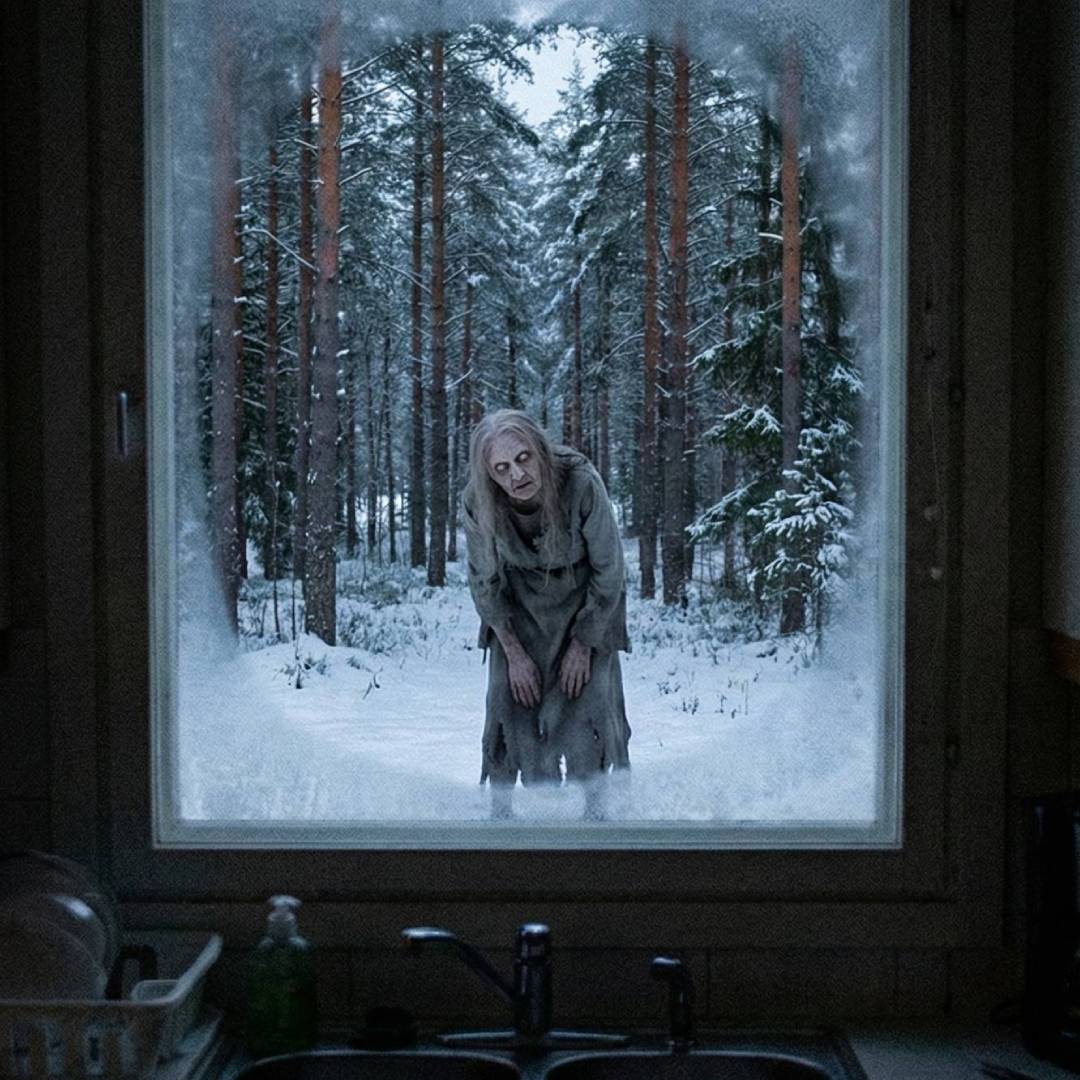
She looked out the window, past the frosted glass, toward the tree line—the dense wall of dark pines that bordered their property.
Standing just inside the shadow of the trees was a woman. She was impossibly old, her posture bent so low she looked like a broken question mark. She wore layers of rags that matched the grey of the winter bark, making her nearly invisible. She wasn’t moving. She wasn’t asking for help. She was just watching.
Her gaze was fixed intensely on the window. Not on Sarah’s face, but lower. She was staring directly at Sarah’s swollen belly.
Sarah dropped a plate. It shattered, the sound like a gunshot in the silent house. When she looked back up, the woods were empty.
From that night on, the scratching started. It wasn’t on the glass of the window; it sounded like it was coming from inside the walls. It was a rhythmic, wet scratching, like fingernails digging into drywall. Scritch. Scratch. Pause. It moved around the house, following Sarah from room to room.
Sarah called the local sheriff, a tired man who dismissed it as “settling timber” or “bobcats.” He didn’t even drive out to check. “Folks see things in these woods when they ain’t used to the quiet, Ma’am,” he said. “Lock your doors and get some sleep.”
She locked every door. She nailed the windows shut. But locks only work on things that respect the laws of physics.
Part IV: The Night of the Debt
On February 12th, a massive blizzard hit the county. David was stuck in Ohio, his rig jackknifed on the icy interstate. The phone lines went dead at 6:00 PM. The power followed an hour later.
The farmhouse was plunged into absolute, suffocating darkness. The silence was deafening, broken only by the wind howling like a wounded animal around the eaves. Sarah lit every candle she could find, creating small islands of flickering light in the ocean of shadows. She barricaded herself in the nursery, clutching a butcher knife, sitting in the rocking chair meant for nursing her son.
She knew the woman was coming. The air in the house had changed. The temperature dropped twenty degrees in minutes, and that smell—wet fur and burning hair—began to seep under the nursery door.
At 3:00 AM, the scratching stopped.
Downstairs, the heavy oak front door didn’t break open. It didn’t smash. The deadbolt simply clicked. The sound echoed through the house.
Sarah stopped breathing. She heard footsteps on the stairs. They weren’t human footsteps. They were wet, heavy, and dragging. Slap. Drag. Wheeze. Slap. Drag. Wheeze.
They moved agonizingly slow, savoring the terror. Sarah wanted to scream, to run, to jump out the window, but her body betrayed her. Her limbs felt heavy, filled with lead. A paralysis took hold of her—not sleep paralysis, but a primal freeze response. She was trapped in the rocking chair, tears streaming down her face, the knife trembling in her hand.
The nursery door creaked open.
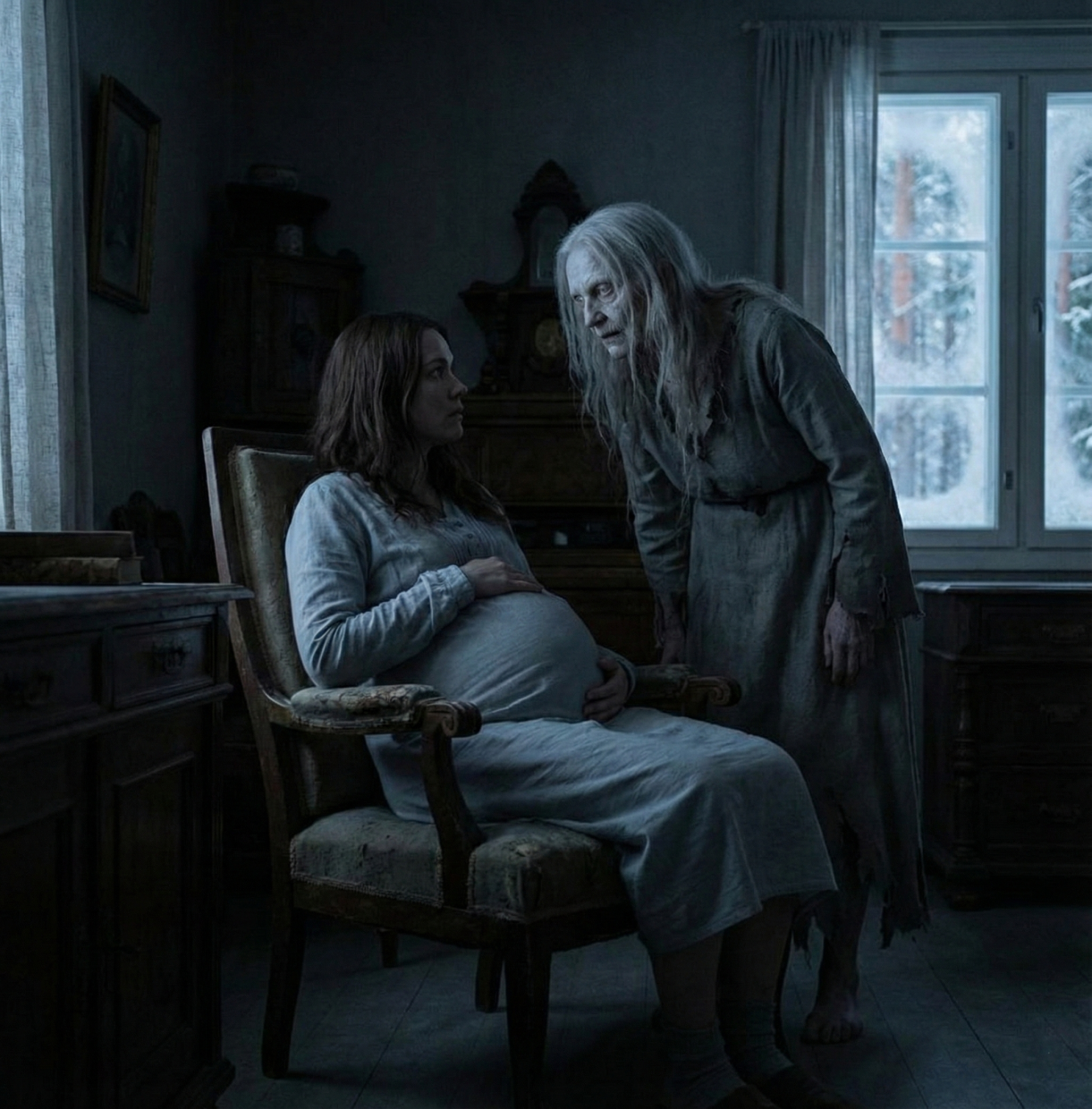
The candlelight flickered violently, then steadied. The woman from the woods stood in the doorway. Up close, she was a nightmare of biology. Her skin looked like wet parchment stretched over jagged bone, translucent and grey. She had no lips, just a gash of a mouth filled with blackened gums. Her eyes were entirely white, clouded by centuries of cataracts, yet she saw everything.
She stepped into the room. The temperature plummeted so low Sarah could see her own breath. The witch didn’t look at Sarah’s terrified face. She looked only at the stomach.
The witch moved closer, her movements jerky and unnatural, like a marionette with tangled strings. She reached out a hand, her fingers unnaturally long and blackened by frostbite, tipped with yellow, curved nails.
Sarah tried to slash with the knife, but her arm wouldn’t move. The witch swatted the weapon away with shocking strength, sending it skittering across the floor.
She placed her freezing, dead palm directly onto Sarah’s stomach.
Sarah felt her baby thrash violently, harder than he ever had before. It wasn’t a kick of joy; it was a kick of panic. The unborn child was squirming, trying to retreat, trying to get away from the cold touch of the thing outside.
The old woman leaned down, her face inches from Sarah’s. Her breath smelled of raw meat and old earth. She didn’t speak in English. She spoke in a guttural, clicking language that sounded like rocks grinding together deep underground.
Then, she switched to English, her voice sounding like dry leaves skittering on pavement:
“The fruit is ripe. The debt is paid. The blood is signed.”
She began to hum a lullaby. It wasn’t a sweet tune. It was a discordant, vibrating melody that made Sarah’s teeth ache and her vision blur. The room began to spin. The last thing Sarah remembered was the sensation of cold, dead fingers digging into her skin, tracing the shape of her womb, and the sound of the witch laughing softly.
Part V: The Mark
David arrived fourteen hours later, hiking the last two miles through waist-deep snow after abandoning his truck. He found the front door wide open, snow drifting into the hallway.
He found Sarah unconscious in the nursery, curled into a fetal ball in the corner. She was blue with cold, dehydrated, and in shock.
She was rushed to the county hospital where she underwent an emergency C-section. The distress to the baby was severe.
The boy was born alive, screaming with a set of lungs that surprised the nurses. But as they cleaned him off, the room went silent. The doctor looked at the nurse, then at David, his face pale.
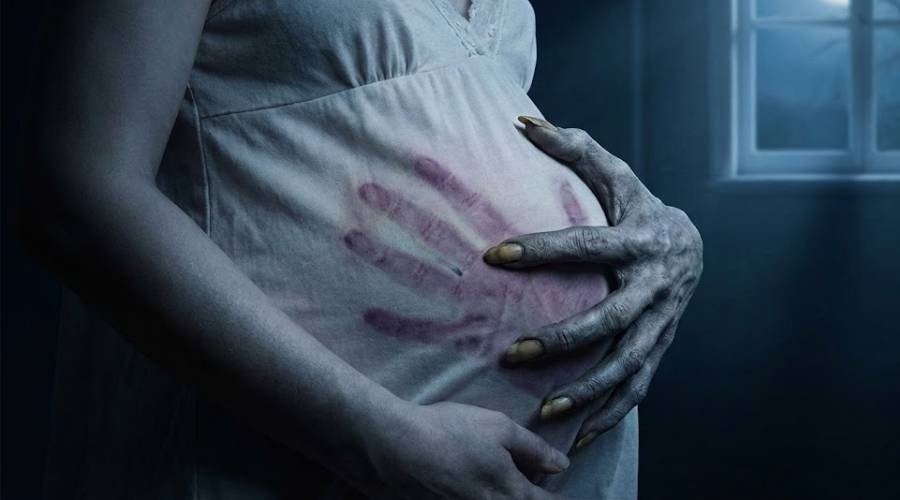
On the infant’s soft, pink stomach, right above the navel, was a birthmark. It wasn’t a random blotch of pigment.
It was a perfect, hand-shaped bruise. Four long, thin fingers and a thumb, branded into the skin in a deep, violent purple. The size of the hand was twice that of a normal human.
The Aftermath
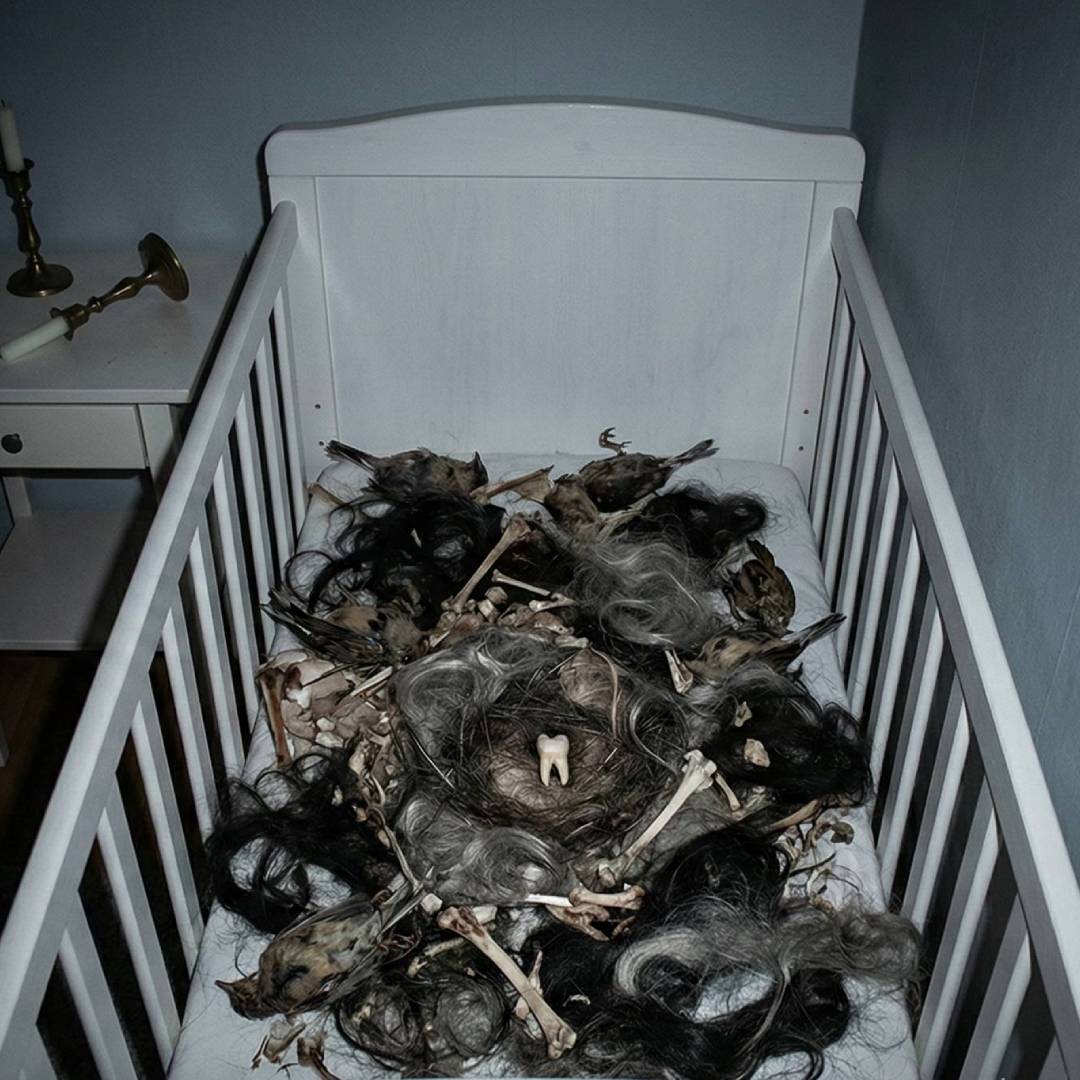
Sarah never returned to the house on Blackwood Creek. David went back once, with two police officers, to retrieve their belongings. They found the nursery destroyed—not by violence, but by nesting. The crib was filled with dead birds, bones, and woven hair.
They sold the property at a massive loss.
Years later, a local historian contacted Sarah. He had been looking into the property deeds of that valley. He found records of a woman named Elspeth, a midwife who lived on that land in the late 1800s. Legend says she was accused of witchcraft after three babies in the village vanished the night they were born. The villagers claimed she sustained her unnatural life by feeding on the vitality of the unborn. She was chased into the woods during a blizzard and never seen again.
Sarah’s son is twenty-six years old now. He is healthy, strong, and intelligent. But Sarah says the horror never truly left them. She claims that sometimes, when the moon is full and the winter wind blows from the mountains, the birthmark on his stomach turns a darker shade of purple.
And sometimes, deep in the night, she finds him standing by the window, staring toward the woods, humming a discordant tune that sounds like rocks grinding together.

About the author
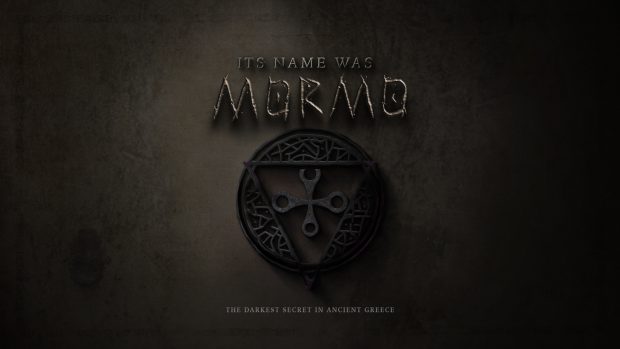
‘Its Name Was Mormo’ Review: Fear-filled Hearts & Close Encounters
In Mark Bower’s staggering handmade visionary tale, his first movie has drawn the attention of nine international film distributors. A Haunting Tale Mark Bower's handmade visionary performance, "Its Name Was Mormo," is a haunting exploration of fear and the supernatural, capturing audiences with its raw and immersive storytelling which delves into the realm of psyche horror, evoking a sense of dread that lingers long after the camera battery dies. Plot and Atmosphere Set in a desolate, rural town, Its Name Was Mormo > follows the unsettling experiences of a family who encounter an evil entity known as Mormo. The film masterfully builds tension through its eerie landscapes, unsettling silence, and the palpable fear of its characters. Bower’s attention to detail in creating a chilling atmosphere is evident, as each scene is infused with an impending sense of doom. The narrative is […]

The Complete Saw Franchise Is Now Streaming on Peacock: A Definitive Guide for Horror Fans
Horror fans have a major reason to celebrate. One of the most influential and brutal horror series of the 21st century is now easier than ever to revisit. The entire Saw franchise is officially streaming on Peacock, giving viewers instant access to all ten films in the iconic saga. Whether you’re a longtime fan of Jigsaw’s twisted philosophy or a newcomer ready to experience the traps for the first time, this is the perfect opportunity for a full franchise marathon. This streaming milestone comes on the heels of one of the biggest horror industry stories of recent years: Blumhouse’s acquisition of the Saw franchise in 2025, which reunited original creators James Wan and Leigh Whannell with the property that launched their careers. With renewed creative energy behind the scenes and renewed accessibility on streaming, Saw is once again dominating the […]

Sundance Film Festival 2026 Midnight Lineup Brings Bold New Horror Films and Genre-Bending Premieres
The Sundance Film Festival 2026 is shaping up to be an unforgettable event for fans of independent cinema, especially those with a taste for horror, dark comedy, and boundary-pushing storytelling. As the iconic festival prepares for its next edition, organizers have officially revealed the 2026 program slate, and it’s packed with buzzworthy titles that promise sleepless nights and thought-provoking experiences. Taking place January 22 through February 1, 2026, the Sundance Film Festival will once again return in person to Park City, Salt Lake City, and the Sundance Resort, while also offering a curated selection of films online starting January 30. Festival packages and passes are already available through Sundance’s official website, giving cinephiles early access to one of the most influential film festivals in the world. With a strong focus on independent horror films, innovative documentaries, and daring new voices, […]
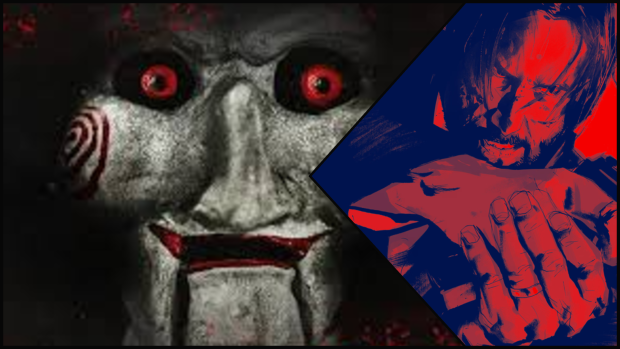
Lionsgate Hints at New AAA Horror Video Games Based on John Wick and Saw
The worlds of film and gaming continue to collide, and Lionsgate appears ready to make a major move into the AAA video game space. During a recent Q2 2026 earnings call, Lionsgate Motion Picture Group chairman Adam Fogelson teased the possibility of big-budget video games based on some of the studio’s most recognizable franchises. Among the properties specifically mentioned were John Wick and Saw, instantly igniting excitement among action and horror fans alike. According to the earnings call transcript shared by Seeking Alpha, Fogelson emphasized that Lionsgate is seeing “increased interest and increased opportunity” in developing premium games based on its intellectual properties. While the comments stopped short of a formal announcement, the wording strongly suggests that Lionsgate is actively exploring major gaming projects tied to its most successful brands. Lionsgate’s Growing Focus on AAA Video Game Development In recent […]
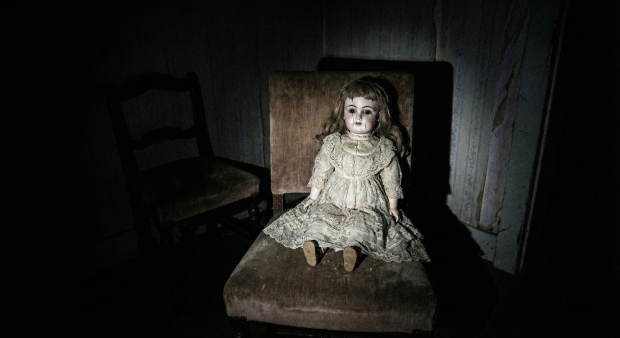
Horror Story – The Porcelain Whisperer
A forgotten relic in the basement awakes, beckoning the eldest daughter into the darkness. The old Victorian house on Elm Street always felt a little too big for the Miller family, and definitely too quiet at night. During the day, it was full of life. Mommy (Sarah) was always baking or working in her home office, while Daddy (Tom) was busy fixing things that constantly broke in the aging structure. Six-year-old Lily filled the hallways with laughter, usually chased by Barnaby, their lazy orange tabby, and Luna, a sleek black cat who seemed to see things no one else did.[Horror Story] Fourteen-year-old Elara, however, found the house unsettling. It started a month after they moved in. At first, Elara thought it was just the wind whistling through the old chimney. It was a faint sound, barely a scratch on the […]
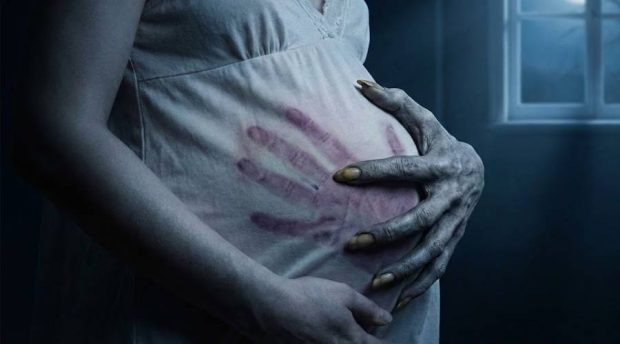
Horror Story – The Midwife of Blackwood Creek
Disclaimer: The following narrative is constructed from a collection of recovered journals, police transcripts from the fateful night of February 12, 1998, and interviews with the surviving family members. To protect their privacy, names and specific locations in West Virginia have been altered Part I: The Isolation The isolation of the Appalachian Mountains is deceptive. In the summer, it feels like a green, lush embrace. But in the dead of winter, when the trees are stripped bare and look like skeletal fingers clawing at the grey sky, it feels like a cage. For Sarah and David, the farmhouse on Blackwood Creek was supposed to be their sanctuary. Purchased for a suspiciously low price in the late autumn of 1997, it sat on forty acres of dense pine forest, miles away from the nearest paved road. Sarah was eight months pregnant, […]
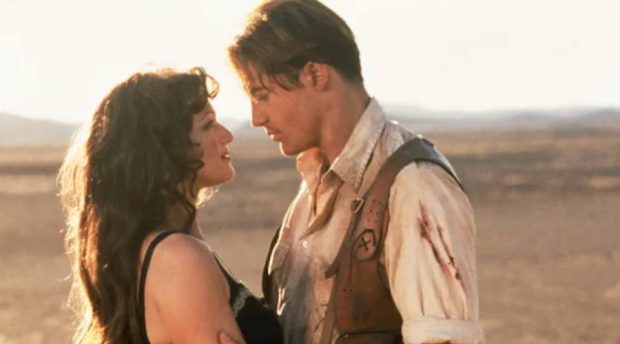
‘The Mummy’ Lee Cronin and Blumhouse Resurrect the Classic Monster for an April 2026 Release
The director of Evil Dead Rise is bringing a terrifying, horror-first approach to The Mummy, leaving the action-adventure style behind. Universal Pictures is taking another stab at their classic monsters, and for The Mummy (2026), they have recruited one of the most exciting voices in modern horror: Lee Cronin. After the massive success of Evil Dead Rise, Cronin has been tapped to write and direct a new version of The Mummy, set for release on April 17, 2026. This is not a sequel to the Brendan Fraser films, nor is it related to the Tom Cruise flop. This The Mummy is pure nightmare fuel. Lee Cronin has publicly stated that his vision for The Mummy is "dark, scary, and violent." Gone are the campy one-liners; The Mummy (2026) returns to the character's roots as a figure of undead dread. The […]
Related
Horror Story – The Porcelain Whisperer
A forgotten relic in the basement awakes, beckoning the eldest daughter into the darkness. The old Victorian house on Elm Street always felt a little too big for the Miller family, and definitely too quiet at night. During the day, it was full of life. Mommy (Sarah) was always baking or working in her home office, while Daddy (Tom) was busy fixing things that constantly broke in the aging structure. Six-year-old Lily filled the hallways with laughter, usually chased by Barnaby, their lazy orange tabby, and Luna, a sleek black cat who seemed to see things no one else did.[Horror Story] Fourteen-year-old Elara, however, found the house unsettling. It started a month after they moved in. At first, Elara thought it was just the wind whistling through the old chimney. It was a faint sound, barely a scratch on the […]

Scary Story – Tequendama Falls
The Cry Beneath the Falls The Haunted Horror of Tequendama Falls and Hotel del Salto They say the water never forgets. South of Bogotá, Colombia, hidden in the Andean mist, Tequendama Falls crashes 515 feet into a chasm carved by time. It's breathtaking. It’s sacred. It’s cursed. The locals don’t come here after dark. They say the wind carries screams — not from the rocks, but from the souls who leapt. The ones who never left. And if you dare listen closely...You’ll hear her crying. Night One Elena arrived with a backpack, a DSLR, and an unhealthy obsession with forgotten places. Her hostel room overlooked the crumbling bones of the infamous Hotel del Salto — a colonial-style mansion turned hotel, then museum, now mostly a shell clinging to the edge of the abyss. “People used to jump from the windows,” […]
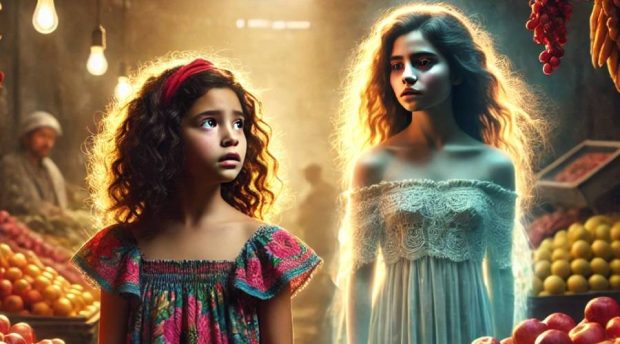
Echoes of a Lost Sister – Suspense, Drama and Horror Stories
Echoes of a Lost Sister - Suspense, Drama and Horror Stories - A Journey Through Grief, Shadows, and the Power of Connection My name is Ximena, I am ten years old, and I live in a house that, while it looks perfect from the outside, hides shadows that not everyone would notice. My family... well, they’re a bit strange. My mother, while affectionate with me, has always been distant. I’ve never lacked her love, but it feels cold, detached. My father... I barely see him. He’s always working, absent, but thanks to him, we live comfortably. The truth is, I don’t feel his absence as much as I do that of my older sister. She, Sofía, is different. She’s seventeen, but she seems to have lived an eternity of torment that no one can understand. She’s always angry, doesn’t smile, […]
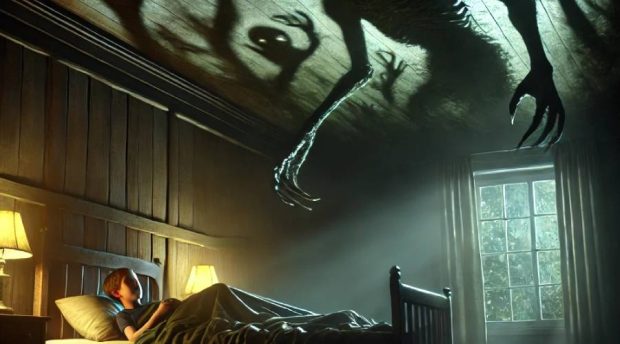
The Haunted House of 1995 – Best Horror Stories
The Haunted House of 1995 - Where the shadows see you before you can escape When I think of that year, 1995, fear still runs down my spine. I was only nine years old and wasn’t prepared for what was to come. My family, made up of my parents and me, moved to a house on the outskirts of Texas, a house much bigger than we needed. When my father saw it for the first time, his face lit up. "This is it," he said. The price was incredibly low for such a huge house. My parents thought they had found a unique opportunity, but I felt something different, something I couldn't explain in words at my young age. When we arrived at the house, my parents' excitement was palpable. However, I didn't share that emotion. The house was in […]
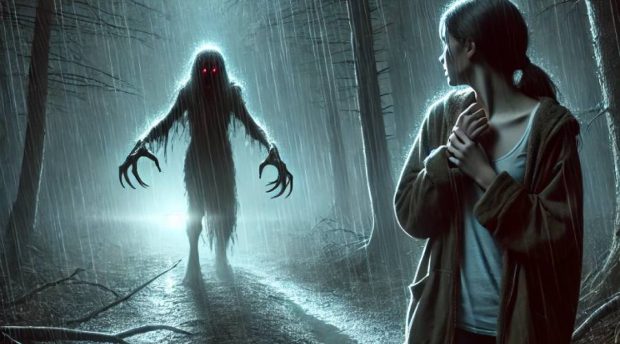
“Innocent Promise, Eternal Condemnation” – Horror Stories
"Innocent Promise, Eternal Condemnation" – When a game triggers a hellish battle for the soul, the price of curiosity becomes an eternal nightmare. It was a cloudy and rainy day, one of those where the sky seems endless, and the sound of raindrops hitting the roof becomes a monotonous melody. I was at home, as usual, surrounded by the solitude that enveloped me. My only companion was Elly, my cat, who was always near me as if she understood that her presence was the only thing keeping me balanced. That day, the dull routine of watching TV while eating cold pizza repeated itself, accompanied by a few beers trying to fill the void. The ring of my cellphone broke the lethargy. Seeing that it was my mother on the screen, a mix of joy and surprise washed over me. She, […]
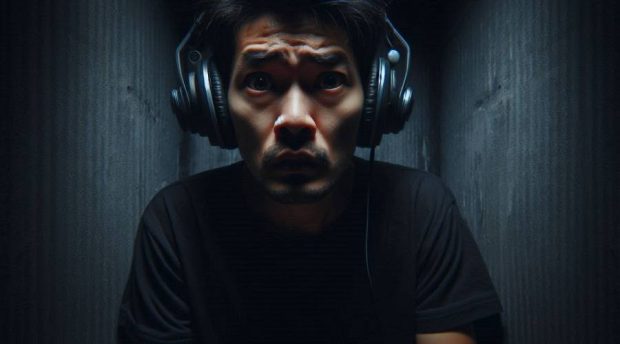
“The Message on the Radio” Stories of Suspense
The Midnight Voice - "The Message on the Radio" Jorge Ávila had been a radio host for nearly two decades. He started his career at local stations in his small town, but his charisma and deep, calming voice earned him a spot on the late-night radio of a major station in the capital. His show, "The Midnight Voice," was known for its blend of soft music, intimate conversations with listeners, and philosophical reflections on life. He often received calls from lonely people, insomniacs, or just those who needed to vent in the darkest hours of the night. The radio booth was located on the top floor of an old brick building, right in the city center. From his window, Jorge could see the sleeping city, the streetlights flickering in the distance, and the distant echo of nighttime traffic. That night, […]